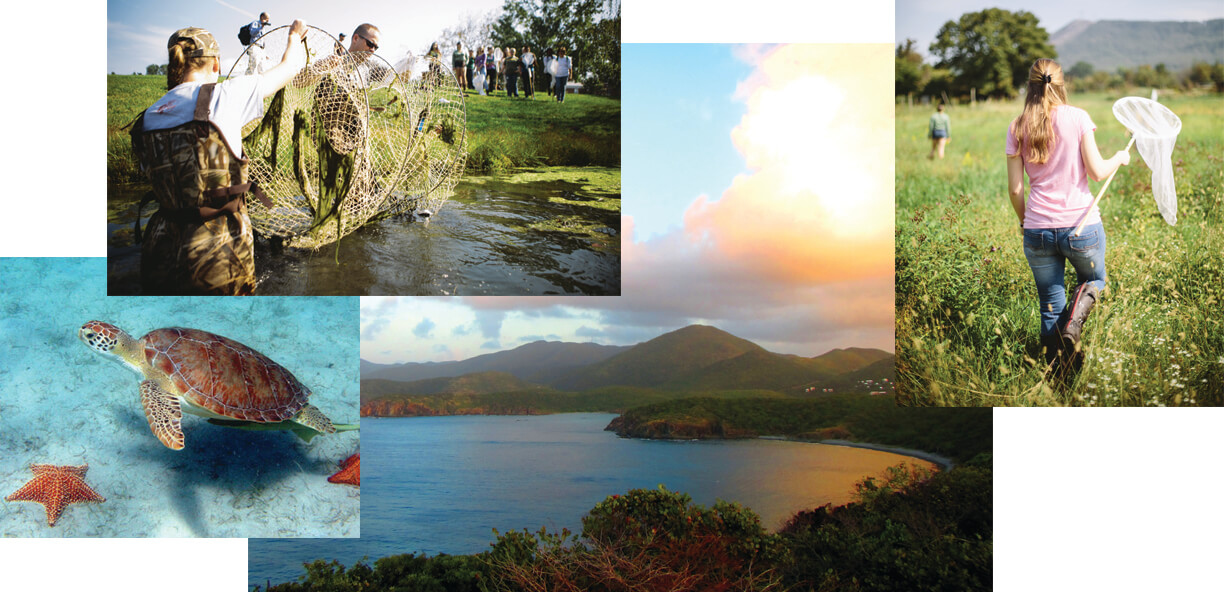
The field of environmental studies and environmental sciences (ES) takes a transdisciplinary approach to understand the relationship between humans and the environment. This field approaches the causes and consequences of environmental problems using skills from the natural and social sciences, the arts, and humanities with a goal to develop potential solutions.
Students pursuing the B.A. degree in Environmental Studies will focus their studies on the cultural and societal issues in human-environment dynamics, while those pursuing the B.S. in Environmental Sciences will take more classes in the natural sciences. In addition, all ES majors are required to undertake a relevant experiential component (internship, study abroad, service project) before graduation.
Degree options
The Hollins ES program has two degree options which share a common core curriculum that provide a grounding in scientific, cultural, and historical perspectives on environmental issues.
Environmental Studies Major
Bachelor of Arts (B.A.) in Environmental Studies
Students in pursuit of their environmental studies degree receive a holistic understanding of local, national, and global environmental issues. Core courses ground students in scientific, cultural, historical, and societal perspectives.
Environmental Science Major
Bachelor of Science (B.S.) in Environmental Science
Environmental science majors focus on developing scientific and quantitative skills. Both the B.A. and B.S. require an internship or service project.
Environmental Studies Minor
This minor meets the core requirements of the major and is geared toward politics and policies.

Courses and Curriculum
Both majors complete a shared set of core courses spanning natural sciences, spatial analysis, and research methodologies before specializing in their degree track:
- Introduction to Environmental Studies (ES 104) and Earth Sciences (ES 105)
- Ecology and Lab (ES 207/L)
- Introduction to Geographic Information Systems (ES 212)
- Political Ecology (ES 261)
- Research Design and Methods for Environmental Issues (ES 262)
Study Abroad Experiences

Partnership with School for Field Studies
Hollins has a formal partnership with the School for Field Studies (SFS) which allows students to go abroad during the regular semester and take courses that will count towards their environmental studies or environmental science degrees. The SFS courses offer place-based study and research opportunities like:
- Marine Resource Studies in the Turks and Caicos
- Wildlife Management Studies in Tanzania
- Rainforest to Reef Studies in Australia
- Himalayan Environment and Society in Transition in Bhutan

Ecuador! A Bio-Cultural Journey on the Equator
In this January Short Term course, students immerse themselves in one of the most biologically and culturally rich countries on the planet.
Over the course of 17 days in the Andean highlands and the Amazon jungle, participants worked at an ecological field station, engaged in home stays with Indigenous communities, volunteered with environmental organizations, and took part in several ongoing research projects related to biodiversity and beyond.